US banks are not modernizing core systems primarily to improve digital experience. They are modernizing because regulatory expectations now require system capabilities that legacy architectures cannot deliver.
Frameworks such as SR 11-7 (Model Risk Management), Basel III Endgame, OCC Heightened Standards, FFIEC cybersecurity guidance, and evolving AML supervision collectively assume real-time data integrity, continuous control monitoring, explainable automation, and operational resilience by design. Most legacy cores were built for stability and batch efficiency, not continuous regulatory proof.
The result is structural tension. Compliance is no longer a downstream review function. It has become an architectural requirement. Core modernization is therefore not discretionary transformation; it is regulatory alignment.
Why US Banking Regulation Now Requires Architectural Change
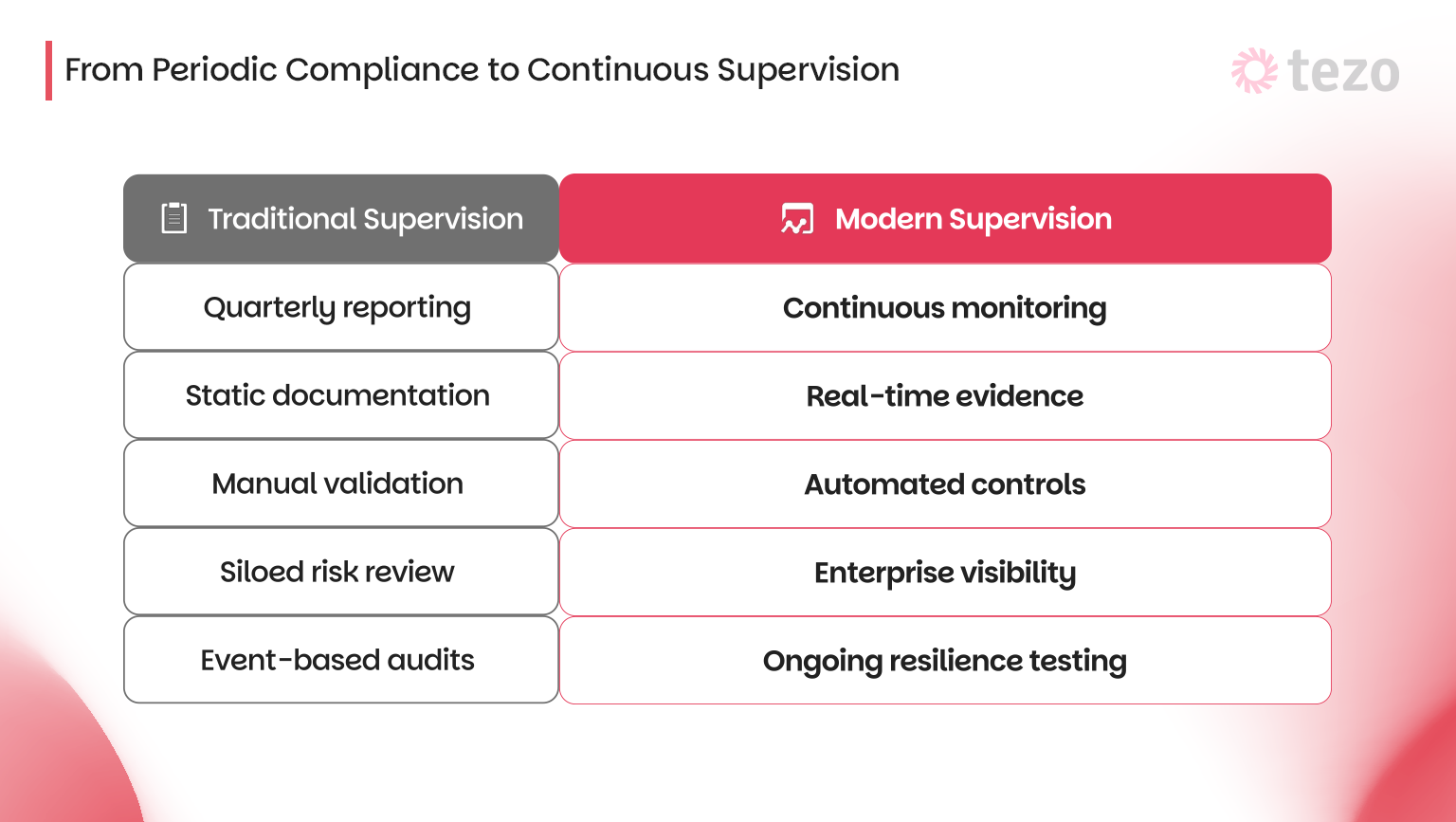
Historically, regulatory compliance relied on documentation, quarterly reporting, and periodic validation exercises. Systems could remain opaque as long as outputs were defensible.
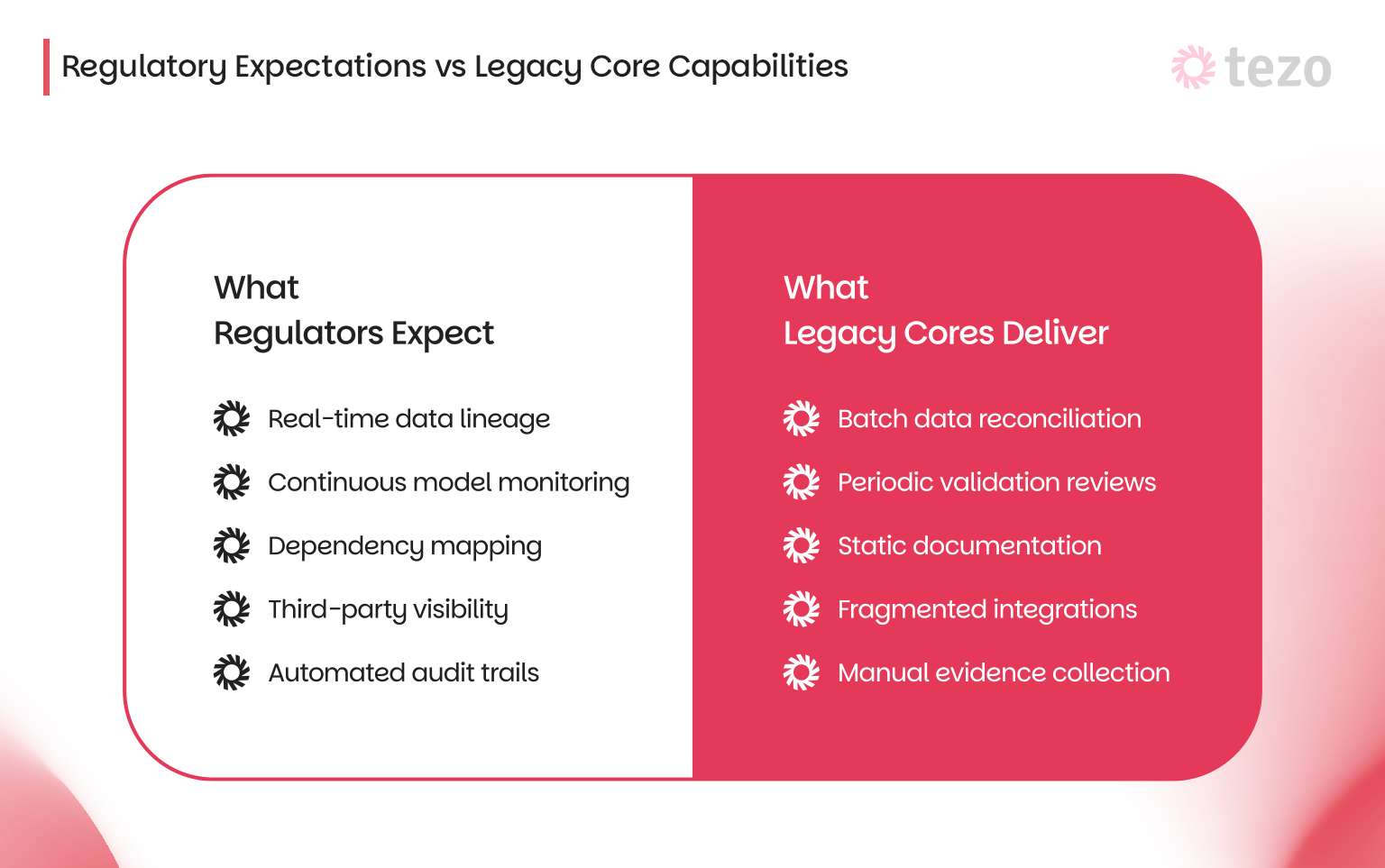
Current supervisory expectations are different. Examiners increasingly expect:
- Traceable data lineage from transaction to report.
- Continuous model performance monitoring.
- Documented governance for algorithmic decisions.
- Mapped system dependencies supporting critical services.
- Ongoing visibility into third-party integrations.
- Near real-time detection of financial crime patterns.
This evolution is visible across major regulatory frameworks.
SR 11-7 and Model Governance in Modern Core Systems
SR 11-7, issued by the Federal Reserve and adopted across supervisory bodies, requires comprehensive lifecycle governance for models deemed material to risk management. In practice, this means centralized model inventories, independent validation processes, documented assumptions, performance monitoring, and escalation protocols for model drift.
As artificial intelligence and machine learning expand across underwriting, fraud detection, liquidity forecasting, and credit scoring, the definition of a “model” broadens significantly. Model governance ceases to be a niche quantitative exercise and becomes a core systems requirement.
Legacy core platforms typically lack native version tracking for deployed algorithms, do not maintain automated validation artifacts, and cannot monitor performance drift without external overlays. Governance becomes fragmented across spreadsheets, documentation repositories, and manual workflows.
Basel III Endgame and the Capital Data Challenge
The Basel III Endgame reforms increase the precision required in capital calculation methodologies and operational risk measurement. These changes amplify the importance of consistent data definitions, reconciled exposure aggregation, and traceable capital logic across business lines.
Capital adequacy is no longer purely a financial reporting exercise. It is a data governance function spanning multiple systems.
Banks operating on siloed core platforms frequently encounter reconciliation loops when aggregating risk exposures. Data definitions diverge across products, transformations are not uniformly tracked, and capital calculations require manual intervention.
From a supervisory perspective, this introduces capital misstatement risk. From an architectural perspective, it exposes fragmentation that modernization must resolve.
Operational Resilience and FFIEC Cyber Expectations
Recent interagency guidance on operational resilience requires banks to identify critical business services, map their supporting technology dependencies, define impact tolerances, and demonstrate recovery capability under stress.
This forces institutions to answer precise questions:
- Which applications directly support high-volume payment flows?
- What is the failure cascade if a cloud service becomes unavailable?
- How quickly can data be restored without compromising integrity?
- Where do single points of failure exist across infrastructure layers?
Many legacy environments cannot generate dynamic dependency maps. Documentation exists, but it is static and often outdated. Resilience therefore relies on inferred understanding rather than measurable observability.
Supervisory scrutiny is increasingly focused on the credibility of those assumptions.
Third-Party Risk and the Visibility Challenge
US regulators have intensified expectations around third-party risk management, particularly in cloud and fintech ecosystems. Banks must demonstrate ongoing oversight, not just due diligence at onboarding.
That requires monitoring of API data flows, contractual control validation, performance metrics, and change traceability across vendors.
In practice, institutions often integrate third-party services faster than they integrate governance controls. The architecture evolves into a distributed network without centralized visibility. Regulatory oversight does not distinguish between internal and external failure. The accountability remains with the bank.
BSA/AML Modernization and Latency Risk
Anti-money laundering supervision increasingly emphasizes risk-based approaches supported by advanced analytics. Real-time or near real-time transaction monitoring is becoming the supervisory expectation.
Batch-oriented AML systems introduce latency between transaction execution and alert generation. In high-velocity payment environments, this latency carries reputational and regulatory risk.
When monitoring logic is disconnected from core transaction systems, auditability and scenario governance become complex and resource-intensive.
Why Legacy Core Systems Struggle Under Regulatory Scrutiny
Modernization initiatives often stall not because of strategic hesitation, but because compliance validation occurs downstream of engineering decisions.
Architectural changes trigger layered review processes across risk, audit, and compliance functions. Evidence must be assembled manually. Data lineage documentation is reconstructed retrospectively. Model validation artifacts are created outside deployment workflows.
The result is governance drag driven by the cost of proving safety.
Regulators rarely block modernization outright. They require institutions to demonstrate that change does not increase systemic risk. When systems cannot produce that demonstration efficiently, progress slows.
The Hidden Risk of Delaying Core Modernization
Deferring modernization does not preserve stability indefinitely. Legacy environments accumulate technical debt, undocumented dependencies, and manual control points.
Over time, this increases:
- Operational incident probability.
- Reconciliation errors in capital reporting.
- Model governance gaps.
- AML detection delays.
- Third-party integration blind spots.
Supervisory expectations continue to tighten. What was previously tolerated becomes a formal finding.
In this context, modernization is not discretionary innovation. It is risk containment.
Embedding Compliance Into Core Architecture
Institutions that accelerate modernization without increasing regulatory exposure tend to embed compliance within architecture rather than layering it externally.
This includes:
- Automated data lineage generation.
- Integrated model validation workflows.
- Continuous control monitoring embedded in deployment pipelines.
- Modular system boundaries to reduce risk concentration.
- Observability across internal and third-party integrations.
When audit evidence is generated as a byproduct of system operation, governance cycles shorten materially.

How Tezo Supports Compliance-Driven Core Modernization?
Tezo addresses the structural friction between regulatory expectations and engineering execution. Rather than functioning as a superficial modernization overlay, it operates within the governance layer of transformation programs.
It enables automated generation of model governance artifacts aligned with SR 11-7 requirements, continuous data lineage tracking across risk and capital systems, embedded monitoring aligned with operational resilience expectations, and structured audit trails for system changes and third-party integrations.
The objective is not to bypass regulatory scrutiny. It is to reduce the operational cost of satisfying it. When validation is automated and evidence is inherent, modernization regains momentum.
Conclusion
US banking regulations have evolved from outcome verification to systemic transparency. Core architectures built for stability but not observability are increasingly misaligned with supervisory expectations.
Modernization, therefore, is not about digital competitiveness alone. It is about constructing infrastructure capable of continuous regulatory proof.
Institutions that align architecture, compliance, and engineering early will modernize with less friction. Those that do not will continue to encounter stalled programs and escalating supervisory pressure.
If your core modernization program is stalled by regulatory validation cycles, model governance complexity, capital data fragmentation, or resilience mapping challenges, we can help assess where the friction lies and how to remove it without increasing supervisory exposure.
Contact us to discuss how to align compliance, architecture, and execution within your modernization strategy.